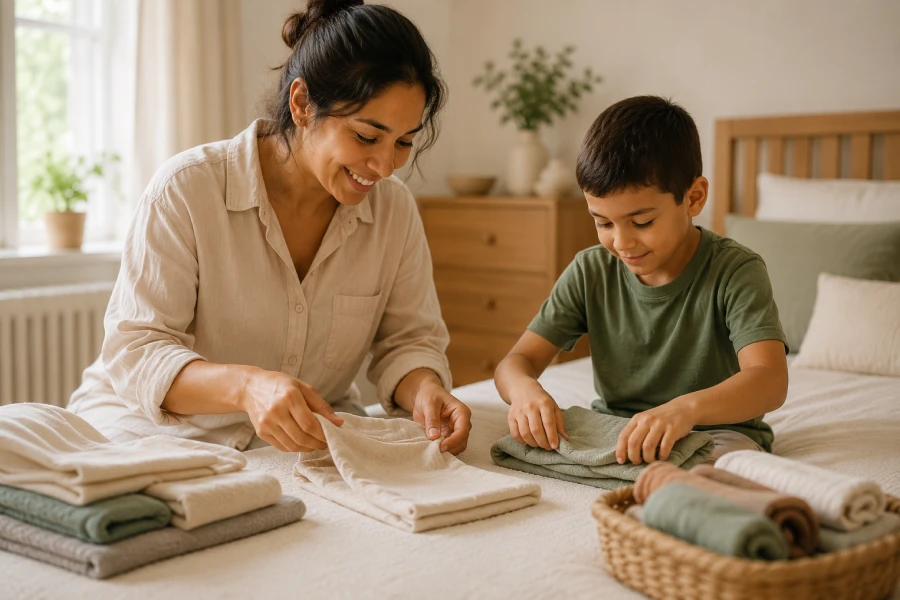
Every familiar household task contains small decisions that children must learn explicitly. Many parents who want capable children but feel frustrated by slow learning find that adults often demonstrate too quickly or take over when results look imperfect. Small choices matter because skills become durable when children understand both sequence and purpose. Although teaching children household skills can sound giving instructions once and expecting independent performance, it works best when practical competence develops through modeling, practice, and release. It must also reduce future dependence through steady practice. A workable system must turn chores into useful education. Repeated consistently, those choices confidence grows from real capability rather than empty praise. The article covers demonstration, accessible tools, practice, feedback, safety, and increasing independence. Success means calm instruction that respects the learning curve. Skill-building requires patience with the slower pace of genuine learning.
A calmer teaching move is performing the task slowly while naming only the essential steps. The learning process stalls whenever a fast demonstration can look like effortless magic rather than a sequence. Teaching improves when adults remember that adults often complete familiar chores too quickly for a child to study. The method becomes concrete when pouring detergent, choosing settings, and moving laundry each deserve separate attention, an approach supported by show practice release method. The child gains usable understanding because the child sees where to begin and how to finish. Demonstrate slow demonstrations slowly enough for the child to see each decision. One focused correction protects attention better than a list of every mistake. Tools and timing should make slow demonstrations possible without constant adult rescue. When resistance appears, treat it as information before labeling the behavior. Slow demonstrations becomes independent only after support has been released in stages.
Teaching improves when adults remember that a task becomes harder when supplies are heavy, hidden, or adult-sized. The method becomes concrete when a lightweight spray bottle and small cloth can support safe table cleaning. The child gains usable understanding because practice begins without waiting for an adult to gather everything. The learning process stalls whenever children may appear resistant when the environment blocks independent action. A calmer teaching move is placing safe tools within reach and choosing manageable sizes. Demonstrate accessible tools slowly enough for the child to see each decision. One focused correction protects attention better than a list of every mistake. Tools and timing should make accessible tools possible without constant adult rescue. When resistance appears, treat it as information before labeling the behavior. Accessible tools becomes independent only after support has been released in stages.
The learning process stalls whenever parents sometimes move from demonstration to total independence too quickly. A calmer teaching move is completing several repetitions side by side. Teaching improves when adults remember that shared practice allows immediate correction without turning the moment into criticism. The child gains usable understanding because the child builds memory while support remains available. The method becomes concrete when one person can hold the dustpan while the other learns controlled sweeping, an approach supported by rotating family responsibilities. Demonstrate shared practice slowly enough for the child to see each decision. One focused correction protects attention better than a list of every mistake. Tools and timing should make shared practice possible without constant adult rescue. When resistance appears, treat it as information before labeling the behavior. Shared practice becomes independent only after support has been released in stages.
A calmer teaching move is recognizing what worked before naming one practical adjustment. The learning process stalls whenever a long list of mistakes can erase pride and reduce attention. Teaching improves when adults remember that useful feedback focuses on one change the child can make next time. The method becomes concrete when the floor is clear; next time, start from the far corner is specific. The child gains usable understanding because the child remains open to learning and knows the next target. Demonstrate focused feedback slowly enough for the child to see each decision. One focused correction protects attention better than a list of every mistake. Tools and timing should make focused feedback possible without constant adult rescue. When resistance appears, treat it as information before labeling the behavior. Focused feedback becomes independent only after support has been released in stages.
Teaching improves when adults remember that refusal can signal fatigue, confusion, overload, or a struggle for control. The method becomes concrete when a two-minute start together may unlock a job that felt too large, an approach supported by calm responses to chore refusal. The child gains usable understanding because parents preserve the expectation while solving the real obstacle. The learning process stalls whenever treating every hesitation as defiance may intensify the conflict. A calmer teaching move is checking whether the task, timing, or support level needs adjustment. Demonstrate refusal signals slowly enough for the child to see each decision. One focused correction protects attention better than a list of every mistake. Tools and timing should make refusal signals possible without constant adult rescue. When resistance appears, treat it as information before labeling the behavior. Refusal signals becomes independent only after support has been released in stages.
The learning process stalls whenever sudden withdrawal can create failure while constant supervision limits ownership. A calmer teaching move is moving from demonstration to shared practice, observation, and independent completion. Teaching improves when adults remember that independence grows when adults release one layer of support at a time. The child gains usable understanding because the child experiences progress that feels earned and visible. The method becomes concrete when eventually, the skill becomes part of daily life without a special lesson. Demonstrate gradual release slowly enough for the child to see each decision. One focused correction protects attention better than a list of every mistake. Tools and timing should make gradual release possible without constant adult rescue. When resistance appears, treat it as information before labeling the behavior. Gradual release becomes independent only after support has been released in stages.



Leave a comment